Bone Before Implant: Measuring the Foundation
An implant is only as steady as the bone it sits in. Height, width and the nerve’s path are measured before anything is placed.


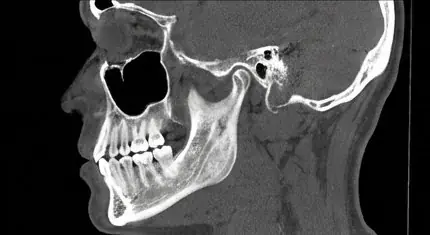
Bone is measured in three dimensions before an implant is planned.Fig. 01
The part no one sees
When people picture an implant, they picture the tooth on top. The part that decides whether it lasts is underneath: the bone the implant is anchored in.
01 · The foundationWhy bone comes first
An implant is a small post placed in the jaw bone, which the bone then grows around and holds. It needs enough bone around it on every side, and it needs to stay clear of the structures nearby.
After a tooth is lost, the bone that held it can slowly shrink. Two people missing the same tooth can have very different amounts of bone left, and it isn’t something anyone can see from the outside.
02 · The measurementsWhat gets measured
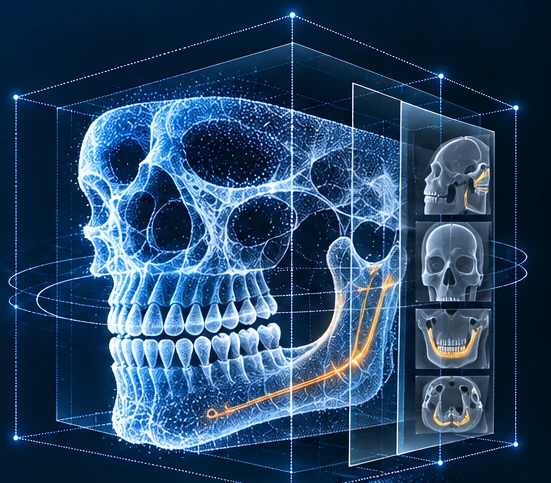
- HeightHow much bone there is above the nerve in the lower jaw, or below the sinus in the upper jaw.
- WidthWhether the ridge is wide enough to surround an implant on both sides.
- The nerve’s pathWhere the nerve runs through the lower jaw, so the implant stays clear of it.
- The sinusIn the upper back jaw, how close the floor of the sinus sits.
Those measurements decide the implant’s length, width, position and angle, and they decide it on a cone beam scan before treatment begins. If there isn’t enough bone, that shows up in planning too, while there is still time to talk through the options.
03 · The principleSave first, replace only what can’t be
The practice’s approach is tiered: save natural teeth wherever possible, replace only what can’t be saved, and move to full implant support only when nothing natural remains. When an implant is the right answer, measuring the bone is how it gets placed well.
“An implant is sized to the bone that is actually there, measured before anything is placed.”
The bone is only half of it. Once an implant is in, the bite it lands in matters too: a T-Scan checks that it doesn’t take the first, hardest hit when the teeth close. And around the implant itself, laser treatment can work on the gum tissue and bone with precision.
04 · The seriesAbout this series
An ongoing series translating what the practice’s instruments actually reveal, one scan, one measurement, one plain-language explanation at a time.
- T-Scan: bite timingRead
- CBCT: bone in 3DRead
- JVA: joint soundSoon
- EMG: muscle effortSoon
- CEREC: fitSoon
- Waterlase: tissueRead
- Implants: bone firstYou’re reading
Words in this reading
Implant
A small post placed in the jaw bone to replace a tooth’s root, with a crown attached on top.
Osseointegration
The process of bone growing onto and around an implant, holding it in place.
Ridge
The arch of jaw bone that once held the teeth, and where an implant is placed.
Sinus floor
The thin layer of bone between the upper back teeth and the air space of the sinus above them.
Thinking about an implant? Start with the bone.
Book a visit at The Smile Galleries in Melbourne, Florida to find out what your bone would support.
Dr. Sangiv I. Patel
Dr. Patel founded The Smile Galleries in Melbourne, Florida in 1995. Thirty years of Physiologic Dentistry: bite, joint, muscle and bone measured as one system before any treatment plan is written.
More about Dr. PatelNew readings, by email
Get the next reading when it’s published.
One plain-language article at a time, by email. No promotions, no schedule to keep up with.